Why illiteracy continues to prevail in Pakistan?
by Sain Sucha
Ever since human beings have accepted the nearness of each other for social existence they have needed some sort of language for mutual communication. It is difficult to say if it was coherent speech or primitive graphology which was used first by our fore-parents for the purpose of systematic communication — probably both evolved side by side, and complemented each other.
The process of speech is based upon our ability to reproduce certain sounds repeatedly in an orderly manner, and our capacity to receive these sound waves in our brain through auditory nerves and break down those chains of sounds into their component units, where each unit functions as a word have such meanings attached to them which are recognised and accepted by the producer and the receiver of those words.
The process of writing is based upon our ability to produce certain drawings[i] repeatedly in such an orderly manner that the meanings attached to them by the producer of the drawing are also recognised and understood by the perceiver of that drawing.
The way drawn symbols, belonging to a language, convey their meanings to their perceivers may be classified into two separate groups:
1. Non-phonological systems, in which there is no relationship between the symbols and the sounds of the language. These systems are roughly composed of:
a. Pictographs — pictures depicting things in universe as they are.
b. Ideographs — abstractions or conventional meanings not directly linked with the object thus represented.
c. Hieroglyphs — a combination of ideographs and phonetic symbols.
d. Logographs — representation of whole words by symbols.
2. Phonological systems, in which the phonetic correspondence between each symbol and the specific sound it stands for is clearly marked.
These systems are divisible into two cases:
A. Syllabic — when each grapheme[ii] corresponds to a spoken syllable, usually a consonant-vowel pair.
B. Alphabetic — when there is direct correspondence between graphemes and phonemes[iii] of a language.
Of all these systems the alphabetic system is the most economical and adaptable for various written languages. It does not have the limitations of pictography, or require several thousand logographs or even dozens of syllables to provide a comprehensive set of symbols for human communication. With a rather limited number of units alphabetic systems cater for a wide range of phonetic reproductions in various languages. Most languages of the world today are based upon alphabetic system; although some important languages still employ the syllabic system.
The spoken language depends mainly upon our sense of hearing and our ability to reproduce those sounds accurately, though to a certain degree eye coordination for the correct use of lips and placement of tongue plays a vital role. When we teach our children to talk we expect them to mimic the sounds which we feed them. Adults mimic most of the time as well, but they also coin new sounds and words through our faculty of abstraction, thus adding new words, expressions and meanings to the existing vocabulary of a language.
The alphabetic systems in the written language depend upon our ability to associate specific sounds to specific graphic symbols, which in combination with each other provide us compound utterances that resemble the spoken words of a language. As Leonard Bloomfield said: "Writing is not language, but merely a way of recording language by means of visible marks."[iv] Reading, thus, would merely be an interpretation of visible marks into comprehensible words of a language. In other words, primarily, learning to write and read does not entail the learning of a new language[v] but simply how to inscribe and decipher specific symbols of a language which we already command.
Disregarding some more elaborate studies in the linguistic structure I shall attempt a much simplified explanation of the process of human communication.[vi]
For my purpose the linguistic communication is divisible into four constituents:
Vocabulary.
Grammar
Technical information.
Emotional content.
Vocabulary and grammar require no new explanation.
By Technical Communication I mean those words and sentences which are used to impart information which has no indirect meanings: "Give me a cup of tea.", "Shut the door.", "Churchill was an Englishman.", "The sun is shining." are a few examples of such communication.
Emotional Content is that part of a sentence where the meanings extend beyond the Technical Communication — often as accompanying nuances and overtones to be understood and felt above, and beyond, the direct meanings: "Give me a nicely made cup of Jasmine tea.", "Please, shut the door, gently!", "Churchill was a well known Englishman.", "The sun is up and shining beautifully." are examples of sentences containing emotional hues of simple order. A gifted mind can induce far more information through the emotional content in a sentence than the words in it may seem to stand for in their dictionary meanings.
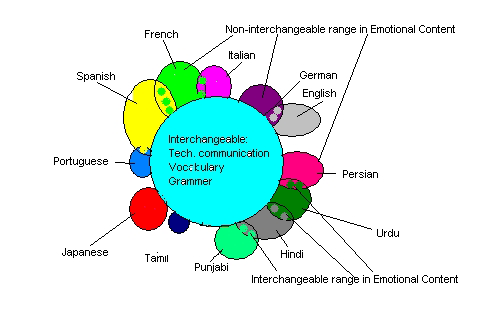
The vocabulary, the grammar and the technical communication in a language is generally easily interchangeable with that of another language of a similarly developed structure; whereas the emotional content is peculiar to each language and accessible only to those people who reached it as a child; and in some very few case, and to a certain extent only, to those who might have migrated to the geographical area of a particular language and learnt the language there. Quite often even the same language spoken in different parts of the world, in spite of its common Grammar, similar Vocabulary and Technical Communication structure, may vary strongly in its Emotional Content, as is the case with English used in the British Isles, USA, Australia, and the West Indies, or with Arabic spoken in Saudi Arabia, Egypt and parts of North Africa. Thus, the vocabulary, the grammar and the technical information contained in English, French, Arabic, and Urdu can be learnt quite easily by a person and used interchangeable; yet, each language maintains its emotional content mostly to its own sphere of use.
The following diagram gives my idea of interchangeable constituents of different languages and the peripheral contact of the emotional content:
A normal person, let us say an Englishman, may, through adult education, be quite proficient in French, German and Urdu, and wade through the normal daily stream of communication with the speakers of these languages without any apparent hindrance; nevertheless, when it comes down to expressing complex thoughts or a very accurate formulation of an idea then he must rely upon the symbolic language of logic, which lacks the emotional content, or revert to English. Only in the case of persons who are trained from their childhood in more than one language, under relevant geographical conditions, it is feasible that they, perhaps, command more than one language with its emotional content for their understanding.
The fact is that the function of each language is to translate our observations and experience of the phenomena around us and our personal feelings in a written or verbal form to communicate with the others. I have not mentioned the symbolic language by gestures because it has a very limited application, as in the case of speech hindered persons, theatre, or where it is a representation of the spoken language as done by raising the middle finger or winking. The potential of each language to translate our mental impressions into linguistic form depends entirely upon the possibilities and variations available to study the range of similar and dissimilar experiences in a certain place. The larger the range in the field of observations the greater will be the number of words and expressions coined to register the study.
The geography plays a very important role in the development of a language. Even in the case of related experiences in different parts of the world the similarity of the words and expressions used can be very superficial:
Let us take an imaginary transportable garden filled with roses in full bloom on a sunny spring afternoon. A likely assumption is that a description in English of the said garden placed in London should apply adequately to the same garden if it was placed in Lahore. This assumption will hold if the description is used for only technical communication, but prove to be misleading in its emotional communication. To a visitor in mild London the roses in the garden infuse the wind with gentle sweet fragrance, while the soothing sunlight arises from the open petals to inspire the eyes with beautiful hues. The experience is stimulating and exciting. In hotter Lahore the wind from the rose garden would overwhelm our visitor with arousing aromatic scent while burning sun rays bounce from the open petals and dazzle the eyes with glaring colours. The experience is exciting and orgasmic. When the visual effects are transformed to the local languages — English and Punjabi — each language would carry words and expressions, and the feelings ascribed to them, which correspond to the intensity of the impact felt by the visitors to the same garden but in two different places. The senses of the visitors were exposed to similar but not identical experiences. Thus if a Punjabi and an Englishman were given a colour photograph of the garden and asked to write their impressions, they should use very different emotional language. Even if they were asked to write in English and used identical words and grammar imparting same technical information, they would still be conveying a very different emotional content.
Thus, beside words, grammar and general idioms about universal truths every language contains expressions which are applicable to the observation of natural and emotional conditions within the geographical range of that particular language.
For a normal person the vocabulary, the grammar and the technical communication comes within the cognitive range of the mind, while the emotional content belongs to the non-cognitive.
This very emotional content is the ingredient which is denied to the majority of the Pakistanis when Urdu, Arabic or English is fed to them in over-doses in their schools, newspapers, radio, TV and other public communications, without anyone of them personally identifying with these languages. It is not the knowledge of grammar, substantial vocabulary or the ability to report a certain information accurately which endear a language to its speaker, but the personal affinity and degree of intimacy which the speaker feels for a particular language. It takes continues reinforcement of the learnt material to reach proficiency in any language. The children in Pakistan learn one language in their schools and then spend rest of their time at home with their relatives or friends speaking another. How could one expect them to be proficient in a language with which they have no emotional contact, and have the possibility of practising it with elders who are incapable of teaching them correct pronunciation, syntax or grammar?
For the most subtle thinking, I believe, one condition is that even the first three constituents of the language be transcended to the non-cognitive understanding and reproduction of ideas. A person must feel completely at home in a language so that his flow of comprehension of the vocabulary, the grammatical structure, the technical communication and the emotional content should proceed without conscious effort.
If by literacy we mean the ability of a person to read and write his language then, as discussed above, the process of reading and writing for that person does not mean mastering an alien language, but merely comprehending the association between the written symbols and their phonetic expression. Every person who can speak a language already has a storage of words, expressions and ideas in his mind. To make him literate all that is needed is to show him the systematic relationship between the written symbols — letters of alphabet — and their phonetic reproduction. Teaching that person to write requires training him to inscribe the phonetic sounds in the form of letters. Now, greater the vocabulary and the range of phonetic utterances of that person in a language the easier it is for him to learn to inscribe maximum number of words and sentences in a minimum length of time. On the other hand the fewer the references in his mental storage the more difficult it will be for him to comprehend the relationship between written symbols, phonetic expressions and memorise the vocabulary of an unfamiliar language.
In Pakistan the authorities, by insisting upon the people to learn to read and write Urdu, English, or Arabic, have burdened the minds of their people not merely by the effort required to learn to read and write, but by forcing them to learn new languages — languages for which these people neither have vocabularies, nor any grammatical and emotional references in their mind. No wonder illiteracy continues to prevail in Pakistan, despite over four decades of labour by the teachers. Had the authorities tried to teach these people to read and write their own languages the situation would definitely be a different one! And once a person has learnt the art of converting written symbols and phonetic expressions of his language into each other, it becomes easier for him to do the same with other languages.
Therefore, if the people of Pakistan want to raise their literacy then they must start with learning their own native language before any other. As I understand the present Urdu alphabet is not comprehensive enough to give full coverage for the inscription of various languages in Pakistan, and serious work is required to elaborate it or devise appropriate alternatives. Already some excellent suggestions are being made for the phonetic improvements in Punjabi[vii], and I hope the same is true for other languages. It is never too late to take the right path, because in the long run it is always the most certain route to progress.
Here I do not intended to degrade Urdu, English or Arabic, because all of them are excellent systems of human communication for the people who command those languages. It is their blatant implementation in Pakistan at the cost of native languages — which are also equally developed systems of communication — that is objectionable. If the authorities are serious about their plans to raise literacy in Pakistan then Punjabi should be taught to the Punjabis, Pushto to the Pathans, Balochi to the Baloachs, Sindhi to the Sindhis, and of course Urdu to the people who consider it as their mother tongue. Quite preferably the languages of other provinces should be introduced in the primary schools of each province to facilitate intercommunication. Bilingualism or multilingualism are common phenomena in the modern world, and Pakistanis should also avail the fertility of the brains of their children, once their mental grounds have been properly prepared for the intellectual cultivation, and starting with the sowing of the seeds of native linguistic matter. Urdu and English could still function as mediums of national and international communication, but only as parallel complementary languages at the local level.
Pakistan has a current population of about 150 millions. That is a lot of people. As compared to that the Nordic countries[viii] have a total population of about 23 millions, with five fully developed and internationally respected languages — Danish, Finnish, Icelandic, Norwegian and Swedish. Of these five Finnish is completely non-related to the other four. Danish, Icelandic, Norwegian and Swedish are related, but each has its own independent literature, style and identity. Their nature is complementary, not exclusive; and that enriches the whole of this area.
The linguistic diversity of the people in Pakistan should also be complementary to their mutual heritage. But that is only possible if each group could create the best they are capable of and share it with others, rather than constructs some meagre thoughts drawn out of limited vocabularies and composed by uncertain and confused minds. In the history of nations five decades do not mount to all that much; yet, human beings have only transitory existence and their resources ought to be used as profoundly as possible. The Pakistanis should also be given the chance to put their thoughts to paper in mediums which come most naturally to them — their mother tongues.
___________________________________________________________________
Books recommended for further reading:
Barber, C.L. 1964. The Story of Language. Pan Books, London, U.K.
Bloomfield, L. 1933. Language. Holt, Rinehart & Winston, New York. USA.
Chomsky, A.N. 1957. Syntactic Structures. Mouton, The Hague.
Chomsky, A.N. 1986. Knowledge of Language. Praeger, New York, USA.
Crystal, D. 1987.The Cambridge Encyclopaedia of Language. Cambridge University Press
Sucha,.S. 1985. The Roots of Misery. Vudya Kitaban Förlag, Sollentuna, Sweden.
[i] Here ´drawings` stands for graphics — system (s) of symbols which represent a language in written form.
[ii] Grapheme: the smallest unit in a writing system capable of producing a contrast in meanings.
[iii]Phoneme: one of the set of speech sounds in any given language that serves to distinguish one word from another.
[iv] Bloomfield. L 1933, Language.
[v] Unless it is intended to learn a completely new language.
[vi] Part of the argument given here, with some minor alterations, is a reproduction from «The Roots of Misery`. Sucha. S. 1985.
[vii] See monthly «Maan Boli`, Lahore. October , 1991, issue.